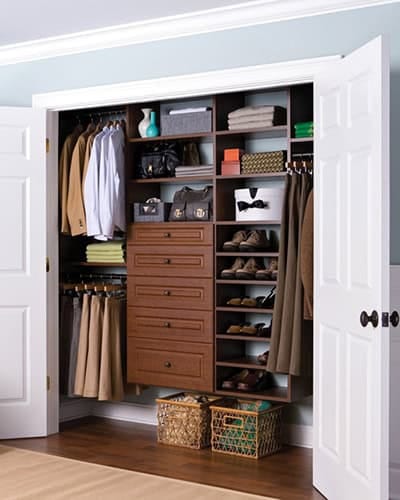

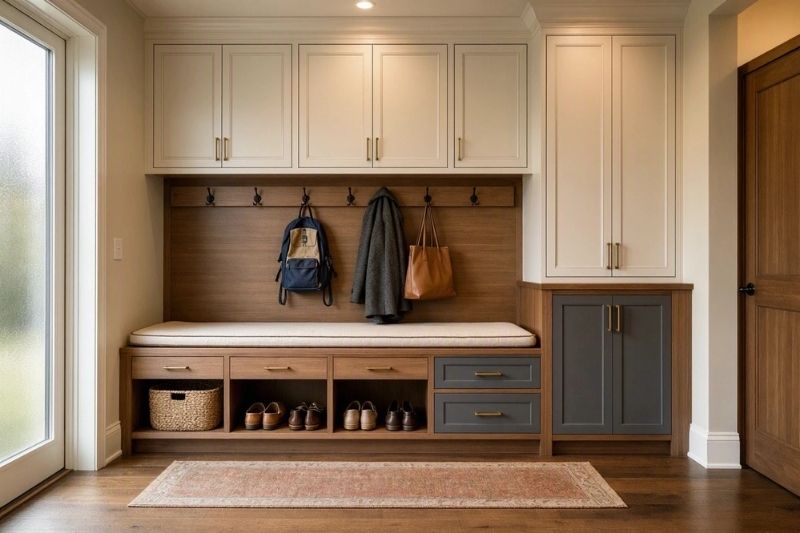
Custom mudroom lockers are built-in storage units designed for one specific space, with a separate section for each person in the house. A typical design pairs a long bench with hooks for coats and bags, cubbies or drawers for shoes below, and cabinets above. Because they’re built to fit your room, they work around doors, windows, and outlets on the wall and look like part of the house.
This guide covers how custom lockers compare with stock units, layout ideas, what to put inside each section, wood and color options, and what to plan before your design consultation. For seat sizes and bench styles, see our guide on mudroom benches with storage.
Custom vs. Stock Mudroom Lockers
Stock units are ready-made and sold in set sizes. Custom units are designed and built for your room. Here’s how they compare.
| Feature | Custom lockers | Stock lockers |
| Size | Built to the exact width and height of your space | Fixed sizes, often leaving gaps at the ends |
| Fit | Cut and fitted so they sit flush against uneven walls and floors | Freestanding units that need anchoring to the wall after setup |
| Materials | Your choice of wood, plywood, finishes, and hardware | Limited to the materials the maker offers |
| Assembly | Built and installed by the design team | Usually arrive in boxes after delivery, and you assemble them yourself |
| Color and style | Matched to your kitchen, laundry, or trim | A short list of stock paint and stain colors |
| Cost | Higher upfront, priced to your design | Typically less expensive |
Stock lockers are typically less expensive than custom options, and they can work in a simple entry. They are easy to find online, though most need some assembly. Custom units make more sense when the room has obstacles, when you want storage that runs to the ceiling, or when the lockers need to match cabinetry nearby.
Custom Mudroom Locker Ideas by Space
A mudroom keeps outdoor dirt and moisture at the door, away from your living areas, but few homes have a dedicated one. Most families work with a garage entry, a hallway, or a laundry room that doubles as the back door.
| Your space | Locker idea | Works best when |
| Garage entry | A run of open sections with a bench, hooks, and cabinets above | The garage is the family’s main way in and out |
| Converted hall closet | Remove the closet doors and build one or two sections with a bench | You have an underused coat closet near the door |
| Corner | An L-shaped bench with lockers on the left and right | Two short walls meet near the entry |
| Dedicated mudroom | Lockers on two facing walls with a bench between them | A large family needs more storage than one side can hold |
| Mudroom and laundry combination | Lockers on one side and laundry cabinets on the other | The back door opens into the laundry room |
| Front entry | Closed lockers with full doors that look like fine furniture | The entry is visible from the living room |
When the back entry and laundry share a room, lockers keep wet towels and sports uniforms one step from the washer. Our guide on choosing cabinets for a mudroom or laundry room explains how to plan both together.
What to Include Inside Each Locker
Think of each section in three zones: low for footwear, middle for daily items at eye or waist level, and high for things you need a few times a year. Dedicated compartments give everything a home, so clutter stops piling up by the door.
- Name plates. Kids are far more likely to hang up a coat when the spot is clearly theirs.
- Two rows of hooks. A low row children can reach now and a higher row they will grow into over the years.
- Shoe drawers or cubbies. Open cubbies are quick for daily shoes, while pull-out trays and drawers keep footwear organized and hide cleats and rain boots.
- A bench at a comfortable height. Federal accessibility standards set accessible bench seats 17 to 19 inches above the floor, a useful benchmark for a home bench. Drawers under the seat are easier to use than lift-up lids.
- Upper cabinets. A home for seasonal hats, beach gear, and spare towels. Adjustable shelves let the storage change as your family’s needs do.
- A drop zone. A shallow drawer for keys, mail, and sunglasses.
- A charging drawer. Plan it early, since it needs an outlet in the right location before the cabinets are installed.
- A tall utility cabinet or pet station. One narrow section for the broom and vacuum, or for leashes, towels, and treats.
Younger siblings can share one section, and you can add a wider open bay for sports bags that will not fit anywhere else.
Door, Wood, and Color Ideas
Open fronts are fast for kids and let damp gear dry. Full doors hide clutter in an entry you can see from the kitchen. Many families split the difference with open sections at hook height and doors on the upper half and the lower drawers.
Shaker fronts suit most homes, and inset doors that sit flush with the frame give a furniture look. Our visual guide to cabinet door styles compares the options.
Wood and color choices set the style of the room:
- A painted finish with a white oak bench. A stained white oak seat adds warmth against a painted cabinet color and puts real wood where hands and bags land every day.
- Natural wood throughout. White oak, walnut, maple, or hickory with a clear finish shows off the wood grain and suits modern and farmhouse homes alike.
- A paint color that hides scuffs. Mid-tone colors like greige, sage, or navy show less wear than bright white paint.
- A back panel behind the hooks. Beadboard or shiplap protects the wall where coats rub.
- Hardware that matches the house. Pulls and hooks in the same finish as your kitchen tie the rooms together. See our guide on cabinet hardware and finishes.
Ask about materials, too. Cabinet boxes are often made from plywood, MDF, or particleboard rather than solid wood. These composite wood products, and finished goods made from them, must be labeled as TSCA Title VI compliant under EPA formaldehyde rules. It is a fair question to ask any cabinet maker, whether you choose plywood or solid wood.
Custom Lockers for Florida Homes: What Most Guides Miss
Most locker inspiration is built around snow boots and wool coats. In North Central Florida, the door sees pool towels, rain jackets, beach bags, and sandy sneakers instead.
Moisture is the big one. The EPA advises drying wet items within 24 to 48 hours to prevent mold growth and keeping indoor humidity below 60 percent, according to its guide to mold, moisture, and your home. A damp towel shut inside a closed cabinet works against both.
- Keep wet-gear sections open, or use ventilated doors so air can move.
- Add towel hooks outside the closed cabinets so wet towels have time to dry.
- Plan a removable tray to catch water and sand, and choose easy-clean flooring like tile below.
- Choose finishes made for humidity, especially on the bench and lower cubbies, since moisture-resistant finishes are simpler to clean and hold up longer. Our guide on the best cabinets for high humidity compares materials.
When Does a Locker Project Need a Professional?
Lockers look simple, but a built-in has to do several jobs at once.
A professional build is worth it when the floor or walls are uneven and the unit has to be cut and shimmed to fit, when full-height units loaded with backpacks need secure anchoring to the wall, when you want outlets for a charging drawer, or when the color and door style need to match existing cabinetry.
Heavy daily use is another reason, since functional materials and durable finishes hold up longer.
Planning Checklist Before Your Consultation
- Which door does your family use most? Plan storage where people come in.
- Who needs a section? Count everyone who uses that entry most days.
- What does each person carry? Note sports bags, work totes, and instrument cases.
- What should be hidden? This decides where doors belong.
- Do you need power? Charging drawers and lighting require outlets, which may mean electrical work is required.
- What should the new storage match? Note your cabinet style, paint color, and hardware finish.
Take photos of the space, including outlets, switches, and vents, so your designer can find any obstacles early. They save time at the first meeting.
How the Design and Installation Process Works
At Pro Closet & Cabinetry, the process starts with a conversation about how your household uses the entry. A designer then measures carefully, accounting for ceiling height, door swing, outlets, and vents, and works through storage zones, wood and color options, pulls, and budget with you. Once you have decided on a design, the team builds the lockers, and they’re installed by the same team. Our article on what to expect during a design consultation walks through the first meeting.
Cost depends on how long the run is, the number of sections, materials, doors, drawers, and hardware, plus any electrical work. The most reliable number comes from a consultation that prices the design you want.
Custom Mudroom Lockers From Pro Closet & Cabinetry
Pro Closet & Cabinetry is a family-run business that has designed, built, and installed custom storage since 2009, with every piece made from wood and other materials at our manufacturing facility in Ocala. Explore related spaces we design:
- Custom mudrooms, from compact lockers to complete rooms
- Laundry room cabinets for mudroom and laundry combinations
- Garage storage for the other side of the door
Ready to Create Your Mudroom Lockers?
If shoes, bags, and coats keep piling up by the door, a custom design can give everyone a spot of their own. Book a design consultation with our team at Pro Closet and Cabinetry and bring your checklist to the first meeting.
Frequently Asked Questions
Are custom mudroom lockers worth it?
They are worth considering when your space has doors, windows, or outlets to work around, when you want closed storage that matches your cabinets, or when the entry sees heavy daily use. A built-in fills the full run instead of leaving gaps around a stock unit.
Should mudroom lockers have doors?
Open sections are easier for kids and let damp items dry, while doors hide clutter in an entry you can see from living areas. Many families add closed cabinets above and drawers below open sections.
What wood is best for custom mudroom lockers?
Painted lockers are often built from plywood or MDF, since MDF costs less than solid wood and paints to a smooth finish. Stained designs use solid hardwoods such as white oak, walnut, or maple. Whatever you choose, ask whether the finish is a durable cabinet-grade coating, such as a catalyzed conversion varnish, especially on the bench and lower sections.
How do I keep mudroom lockers from smelling musty?
Give damp items airflow. Keep sections for towels and rain gear open or use ventilated doors, move wet items to the laundry quickly, and keep indoor humidity in check.
Can mudroom lockers fit in a small space?
Yes. A converted hall closet or a single section beside the garage door can work. Add a row of hooks nearby for extra hanging space. In tight spaces, tall vertical compartments make the most of the room, and open fronts avoid door-swing problems and keep the walkway clear.