
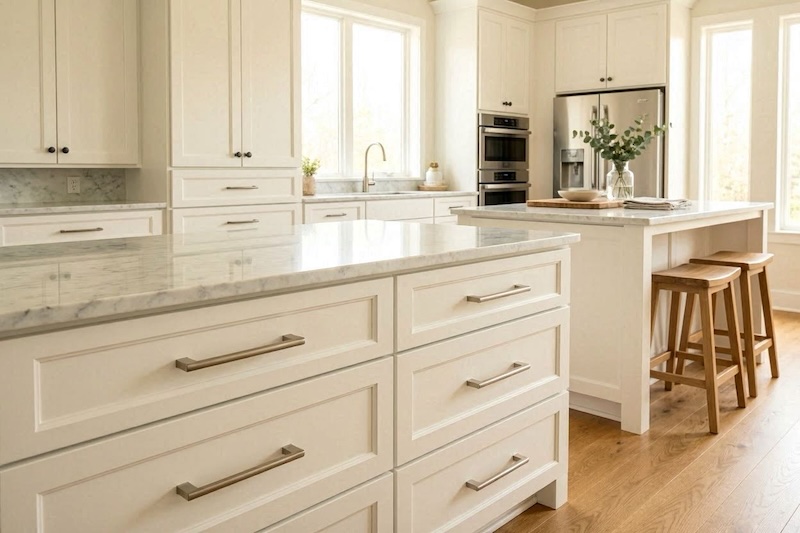
Cabinet hardware is one of the smallest decisions in a kitchen remodel, but it changes how the whole room looks and feels every single day. The right knob or pull can make cabinetry feel more custom, improve comfort, and tie together your faucet, lighting, and appliances. The wrong choice can make a beautiful kitchen feel busy, dated, or awkward to use.
If you want the short answer first, here is the most reliable formula:
- Use pulls on drawers and larger doors for the easiest grip
- Use knobs on smaller doors if you want a softer or more classic look
- Choose a finish that relates to your faucet or lighting, not necessarily every metal in the room
- Size hardware to the cabinet, not just to the current trend
- Decide hardware early, before drilling, so placement stays clean and intentional
That advice lines up with current homeowner behavior. In the 2025 U.S. Houzz Kitchen Trends Study, 93 percent of homeowners chose handles on new cabinets, with bar pulls leading at 75 percent. Knobs were still common at 36 percent, while brushed nickel was the top finish at 31 percent, followed by black at 19 percent and brass at 17 percent.
Why hardware matters more than people expect
Cabinet hardware affects three things at once: style, comfort, and daily function. That matters in a room you use constantly. Houzz reports that homeowners choose new cabinet materials primarily for look and feel at 72 percent, but functionality is also a major driver at 45 percent. In other words, people want kitchens that look polished and work hard. Hardware sits right at that intersection.
This is where Pro Closet & Cabinetry stands out from trend roundups that stop at inspiration. Their custom kitchen cabinets are designed around storage, efficiency, and everyday use, with options like pull out drawers, spice storage, and tailored layouts that help every item earn its place. Their process is about fit and function, not just picking a finish from a catalog.
Knobs or pulls: which one should you choose?
There is no single right answer, but there is a smart answer for each cabinet type.
Choose knobs when you want
- A classic, traditional, or transitional look
- A lighter visual feel on upper cabinets
- A budget friendly update with less visual weight
- A simple shape for smaller doors
Knobs work especially well on cabinet doors, glass front cabinets, and furniture style pieces like a pantry hutch or built in buffet.
Choose pulls when you want
- Easier grip on drawers
- Better leverage on heavy doors or deep pull outs
- A more modern or tailored look
- Cleaner lines across Shaker or flat panel cabinetry
For day to day use, pulls often win on comfort. Houzz even lists wide drawer pulls among the features homeowners add when renovating for aging in place, which reinforces their practical value beyond looks alone.
The best of both worlds
One of the safest and most attractive combinations is simple:
- Pulls on drawers
- Knobs on doors
This mix keeps the kitchen from looking too repetitive while making drawers easier to open. It also works across many styles, from painted Shaker kitchens to warm wood cabinetry.
The hardware styles that work in real kitchens
Trends come and go, but some hardware styles have stronger staying power because they fit the way people actually live.
Bar pulls
Bar pulls remain the most common choice for a reason. They are clean, easy to grip, and work with many kitchen styles. Houzz found they are the dominant handle style on new cabinets. If you want a versatile choice with broad appeal, this is it.
Best for:
- Modern kitchens
- Transitional kitchens
- Slab and Shaker doors
- Busy family kitchens
Round or oval knobs
Knobs soften the look of cabinetry and suit more classic spaces. They are a natural fit for painted cabinets, inset looks, and kitchens with a more collected feel.
Best for:
- Traditional kitchens
- Cottage inspired kitchens
- Smaller upper cabinets
- Accent cabinetry
Cup pulls
Cup pulls bring character and work especially well on drawers in traditional, vintage, or farmhouse inspired spaces. They are less common overall, with Houzz reporting them at 9 percent of handle choices, which can actually make them feel more distinctive when used thoughtfully.
Best for:
- Drawer fronts
- Butler’s pantries
- Furniture style islands
- Classic cabinetry
Edge pulls and finger pulls
If you like a minimal look, edge pulls create a streamlined profile. According to Amerock’s edge pull guide, they are often selected to coordinate with current cabinet color trends, and the brand notes a useful sizing rule: edge pulls should generally be no more than half the drawer width or one third the door height.
Best for:
- Flat panel cabinets
- Contemporary kitchens
- Hidden hardware look
- Smaller spaces where visual simplicity matters
A practical finishes guide
Finish is where many homeowners get stuck, but it gets easier if you think in terms of temperature and contrast.
Brushed nickel
Brushed nickel is the current mainstream favorite, and for good reason. It is easy to live with, coordinates with stainless appliances, and hides fingerprints better than shinier finishes. Houzz lists it as the top cabinet handle finish at 31 percent.
Best with:
- White cabinets
- Gray cabinets
- Stainless appliances
- Transitional design
Matte black
Black hardware creates contrast and definition. It works especially well on white, wood, and green cabinetry. Houzz shows black still holding a strong share, even after a year over year dip, which suggests it has moved beyond a quick fad and into staple territory.
Best with:
- White Shaker kitchens
- Natural wood cabinets
- Modern farmhouse looks
- Strong graphic contrast
Brass and warm metallics
Brass brings warmth, especially in kitchens that need softness or a more elevated custom feel. It pairs beautifully with painted cabinets in cream, deep green, navy, and warm neutrals. Houzz reports brass at 17 percent of handle finishes, while Sweeten also highlights warm brass as a major current preference in designer kitchens.
Best with:
- Cream and greige cabinetry
- Rich painted islands
- Walnut and white oak tones
- Layered lighting
Bronze
Bronze feels grounded and slightly more traditional than brass. It is a smart choice if you want warmth without too much shine.
Best with:
- Medium and dark wood cabinets
- Rustic or transitional kitchens
- Homes with warmer architectural finishes
Chrome or polished finishes
These are less common today, but they can still work in crisp, bright kitchens. Use them when you want more reflection and a cleaner, sharper edge.
How to size and place hardware without second guessing yourself
Good placement makes cabinets feel custom. Poor placement looks accidental, even with premium hardware.
According to the Top Knobs hardware placement guide, knobs and pulls are commonly placed about 2.5 to 3 inches from the corner on cabinet doors. On drawers smaller than 24 inches, one centered knob is typical. For wider drawers, two knobs can work, or a properly scaled pull placed horizontally in the center.
A few easy rules help:
- Use one knob on small drawers
- Use a longer pull on wide drawers
- Keep placement consistent across similar cabinets
- Test with painter’s tape before drilling
- Scale up hardware on pantry doors and large pull outs
If you are replacing existing hardware, center to center measurement matters. Standard screw packages are designed for common door thicknesses, and backplates can help cover old holes when changing pull sizes.
Matching hardware to cabinet style
The easiest way to avoid a mismatch is to pair simple cabinet fronts with simple hardware and more detailed cabinet fronts with hardware that has a little personality.
For Shaker cabinets
Shaker is still the most popular cabinet door style at 61 percent, according to Houzz. That flexibility is one reason it pairs well with almost every hardware family.
Best options:
- Bar pulls
- Mushroom knobs
- Small square knobs
- Unfussy brass or black pulls
For flat panel cabinets
Best options:
- Edge pulls
- Slim bar pulls
- Minimal matte black pulls
- Brushed nickel linear pulls
For traditional or furniture style cabinets
Best options:
- Cup pulls
- Round knobs
- Oval knobs
- Warm metallic finishes
Where custom cabinetry changes the whole decision
This is the part many hardware guides miss. Hardware should not be chosen in isolation. It should be chosen with cabinet layout, pantry storage, drawer depth, and how your family uses the kitchen.
Houzz found that fully customized cabinets account for 45 percent of new cabinet choices, ahead of stock cabinets by a wide margin. NKBA’s 2026 Kitchen Trends report also points to enhanced storage as a growing priority, with 72 percent identifying it as a gaining traction feature.
That is why Pro Closet & Cabinetry has an edge over inspiration only brands. Their kitchen cabinet solutions are built around storage efficiency, while walk in pantries and butler’s pantries extend that same customized thinking beyond the main cabinet run. If your pantry doors, appliance panels, and deep drawers are designed intentionally from the start, your hardware can be sized and placed with purpose instead of compromise.
The smartest way to make your final pick
If you are narrowing down options, ask these five questions:
- Which cabinets get used the most
- Do I want this kitchen to feel warm, crisp, classic, or modern
- Will knobs or pulls be easier for everyone in the home to use
- Does this finish relate to my faucet, lighting, or appliances
- Will this still look right in five years, not just this season
A beautiful kitchen is not built on trends alone. It is built on choices that fit your space, your style, and your routine. When cabinetry and hardware are planned together, the whole kitchen feels more finished, more functional, and more personal.
If you are designing a new kitchen or upgrading an existing one, Pro Closet & Cabinetry can help you create cabinetry that works as beautifully as it looks, right down to the final knob or pull.